
Hybrid Solar–Wind Energy Systems
Decentralized, Building Integrated Power Using Vertical Axis Wind Turbines
Reliable Renewable Energy Through Hybrid Design
This service focuses on the design and deployment of hybrid solar–wind energy systems centered on Vertical Axis Wind Turbine (VAWT) technology, integrated with photovoltaic generation to deliver reliable, decentralized power. Unlike conventional horizontal-axis wind turbines, VAWTs are specifically suited for urban, industrial, and building-integrated applications, where space constraints, turbulence, and variable wind directions limit traditional wind solutions. By combining VAWTs with solar photovoltaics, these hybrid systems provide continuous energy generation across varying weather and diurnal conditions, reducing dependence on centralized grids.
The solution is inherently modular and scalable, enabling deployment across residential, commercial, and industrial environments with minimal transmission losses and high system resilience.
Hybrid solar–VAWT systems enable decentralized energy generation, reduce reliance on centralized grids, and enhance energy security at the point of consumption. By integrating generation directly into buildings and facilities, these systems deliver efficiency gains, resilience, and measurable emissions reductions without the spatial and operational constraints of conventional wind technologies.
Hybrid System Architecture: Complementary Energy Profiles
Biochar uniquely integrates agricultural productivity, climate mitigation, and land restoration into a single, scientifically proven solution. Unlike short-lived interventions, biochar delivers compounding benefits over time, making it particularly well-suited for regions facing soil degradation, water scarcity, and climate vulnerability.
Solar photovoltaic systems generate maximum output during daylight hours, while VAWTs can operate continuously, including at night and during overcast conditions. The hybrid configuration smooths generation variability and improves energy availability over a 24-hour cycle.
Hybrid systems can be designed as:
- Stand-alone (off-grid) systems
- Grid-connected systems
- Hybrid systems with battery storage
Operational and Engineering Advantages
Performance in Urban and Complex Wind Environments
VAWTs perform effectively in turbulent wind conditions commonly found around buildings, ridgelines, hilltops, and passes. Their ability to operate without yaw mechanisms or blade orientation systems simplifies design and improves reliability.
Low Noise and Visual Impact
VAWT blades rotate at lower velocities than horizontal turbines, resulting in quieter operation and reduced visual intrusion—key considerations for urban and commercial applications.
Technology Overview: Vertical Axis Wind Turbines (VAWTs)
What Makes VAWTs Different?
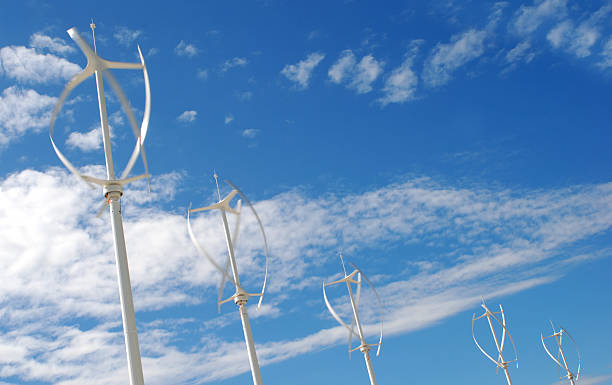
Vertical Axis Wind Turbines capture wind from any direction (360°) and can operate effectively at low wind speeds of approximately 2–3 m/s, making them well suited for urban and semi-urban environments. Their compact size—typically ranging from 200 W to 100 kW—allows for flexible deployment on buildings or within constrained sites where horizontal-axis turbines are impractical.
Building Integrated Generation
VAWT systems can be directly mounted on rooftops or structural elements, placing power generation close to the point of use. This configuration eliminates transmission and cable losses and improves overall system efficiency by supplying energy directly to local loads.
Areas of Application
Decentralized Urban Generation
-
Residential houses and villas
-
Commercial and office buildings
-
Factories and industrial units
Agricultural and Semi-Urban Use
-
Farms and greenhouses
-
Remote or grid-constrained facilities
Industrial and Infrastructure Sites
-
Facilities seeking on-site generation and resilience
-
Buildings requiring supplemental or backup power